Portable RF Drone Detection for Correctional Facility Security
Explore how portable passive RF drone detection supports correctional facility security through additional awareness of unauthorized drone activity and perimeter risks.
Overview
Correctional facilities face growing security challenges from unauthorized drone activity around their perimeters. Small unmanned aircraft systems (UAS) can be used to deliver contraband, observe facility operations, or gather information about security arrangements. Their relatively small size and ability to operate at a distance make them difficult to monitor using conventional perimeter security measures alone.
Portable RF drone detection adds an extra layer of security awareness by identifying radio frequency signals associated with certain drone communication systems. It can complement existing surveillance and perimeter monitoring infrastructure, helping correctional facility security personnel assess potential aerial activity and respond according to established procedures.
Other products by Zaruba Tech
The Drone Challenge for Correctional Facilities
Unauthorized drone activity presents several security concerns for prisons, detention centers, and other correctional facilities. Even a relatively short flight near a restricted perimeter can create operational challenges and require an investigation.
Key risks include:
- Contraband delivery: Drones can transport small packages containing prohibited items, including mobile phones, drugs, communication devices, and other unauthorized materials. Deliveries may be directed toward outdoor areas, exercise yards, or locations near facility boundaries.
- Unauthorized surveillance: Cameras mounted on drones can capture images of facility infrastructure, perimeter barriers, guard posts, surveillance equipment, and operational routines. Such information may expose security weaknesses or support future unauthorized activities.
- Perimeter incidents: Unidentified aircraft operating near restricted areas can trigger security alerts, disrupt routine operations, and require personnel to investigate potential breaches. Repeated drone activity can also place additional demands on perimeter security teams.
These incidents are not always easy to distinguish from legitimate drone operations in surrounding areas. Security personnel need reliable information to assess whether detected activity requires further investigation.
Why Correctional Facilities Need Drone Awareness
Traditional correctional facility security relies on multiple layers, including perimeter fencing, CCTV cameras, motion sensors, access control, and physical patrols. However, these measures primarily address ground-level access and visible activity.
Drones add an aerial dimension that existing infrastructure may not adequately cover. A small aircraft can approach a facility from outside its perimeter, remain airborne near sensitive areas, and leave before personnel can establish its purpose.
Drone awareness helps security teams:
- Identify detectable drone-related RF activity around facility boundaries.
- Gain additional information about potential aerial activity that may not be immediately visible.
- Support investigations into suspected unauthorized drone operations.
- Inform security personnel when further observation or assessment may be necessary.
- Supplement existing perimeter monitoring and incident response procedures.
The objective is not simply to detect every aircraft in the surrounding airspace. It is to provide additional information that helps personnel distinguish potentially relevant activity from the normal operational environment.
Role of Passive RF Drone Detection
Passive radio frequency (RF) detection identifies and analyzes wireless signals associated with supported drone communication systems. Many remotely operated drones exchange data with their controllers through RF links, creating signals that compatible detection equipment can receive.
Unlike active electronic countermeasures, passive RF detectors operate in receive-only mode. They do not transmit RF signals, jam communications, or intentionally interfere with other electronic systems.
For correctional facilities, passive RF monitoring can provide several useful capabilities:
- Signal detection: Identify RF activity within supported frequency bands that may be associated with drone operations.
- Multi-band monitoring: Monitor several frequency ranges used by certain drone communication and video transmission systems.
- Additional perimeter awareness: Provide an RF-based monitoring layer alongside cameras, physical patrols, and other security equipment.
- Operational flexibility: Allow personnel to conduct monitoring at selected locations without installing permanent detection infrastructure.
Passive RF detection has important technical limitations. Its effectiveness depends on the drone's communication technology, operating frequency, signal strength, distance, antenna configuration, and environmental conditions.
It is also important to distinguish RF activity detection from confirmed aircraft identification. A detected signal may indicate potential drone-related activity, but additional information or visual verification may be necessary to establish the presence and characteristics of an aircraft.
Portable vs Fixed Drone Detection
Correctional facilities can consider both portable and fixed drone detection technologies depending on their security requirements, site layout, and operational resources. These approaches address different deployment needs and can complement each other.
Portable drone detection advantages
Portable systems are designed for flexible deployment and can be moved between locations as operational requirements change.
Their advantages include:
- Monitoring selected areas without permanent installation.
- Supporting temporary security operations and targeted inspections.
- Allowing personnel to relocate detection equipment between facility zones.
- Providing additional RF monitoring during incident investigations.
- Reducing dependence on fixed infrastructure for localized monitoring.
Portable equipment can be particularly useful when facilities need detection capabilities at different locations or want to introduce supplementary RF monitoring without implementing a site-wide installation.
Fixed-system advantages
Fixed drone detection systems are designed for continuous monitoring of designated areas. They can be installed at strategic positions around a facility and integrated into centralized security operations.
Their advantages include:
- Continuous monitoring of selected perimeter zones.
- Consistent coverage within the designed detection area.
- Integration with security control rooms and other monitoring infrastructure.
- Support for centralized alert management and coordinated incident response.
Fixed installations are generally more suitable when a facility requires permanent monitoring across defined areas.
Where each technology fits
The choice depends on the operational objective. Fixed systems can provide continuous monitoring of critical perimeter sections, while portable detectors can support targeted monitoring, temporary deployments, and additional RF awareness at selected locations.
A layered approach may combine fixed detection infrastructure with portable equipment to address both continuous coverage and changing operational requirements.
How Zaruba A3 Can Complement Existing Security Systems
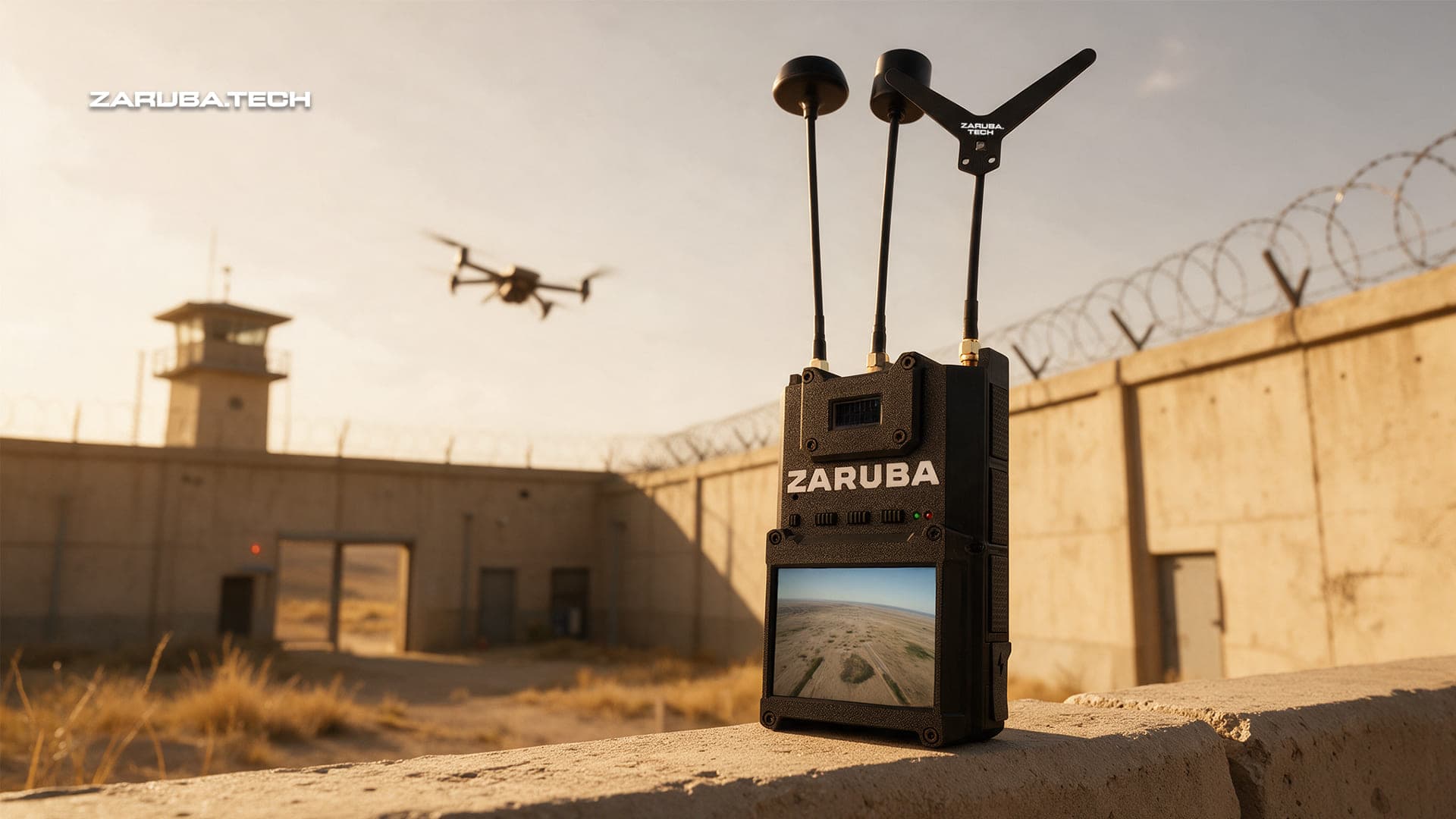
The Zaruba A3 is a portable passive RF drone detector designed to identify analog FPV video signals across three frequency bands: 1.2 GHz, 3.3 GHz, and 5.8 GHz.
For correctional facility security teams, the A3 can serve as a supplementary monitoring device alongside existing perimeter protection systems. Its portable design allows personnel to transport the equipment between operational locations and conduct RF monitoring where additional awareness is required.
Relevant capabilities include:
- Passive detection: Receives supported RF signals without transmitting or intentionally interfering with nearby communications.
- Three-band monitoring: Covers 1.2 GHz, 3.3 GHz, and 5.8 GHz frequency bands associated with analog FPV video transmission.
- Portable operation: A compact, self-contained device that can be relocated between monitoring positions.
- Dual-screen interface: Two integrated displays provide a visual interface for observing detected signals.
- External video output: Allows connection to an external display when required by the deployment setup.
- Offline updates: Supports software updates without requiring a permanent internet connection.
- Battery-powered operation: An integrated 4,500 mAh battery supports operation without continuous external power.
The A3 can complement CCTV monitoring, perimeter patrols, and other security procedures by providing information about detectable analog FPV video signals. Its findings can support further assessment by trained personnel.
The device should be considered an additional RF monitoring layer rather than a complete correctional facility counter-UAS solution.
Deployment Scenarios
Portable RF detection can support different operational scenarios within correctional facility security, particularly when monitoring requirements vary by location or operational activity.
Perimeter monitoring
Security personnel can use portable detection equipment at selected perimeter positions to observe detectable RF activity associated with supported drone signals. This can supplement physical patrols and existing surveillance systems.
Targeted monitoring of vulnerable areas
Certain facility locations may require additional attention because of their proximity to public roads, neighboring properties, or areas accessible to unauthorized drone operators. Portable equipment can be positioned at selected monitoring points as part of a broader security assessment.
Incident investigation
Following a suspected drone-related incident, personnel can use portable RF detection as an additional monitoring resource during subsequent security checks. Detected activity can be considered alongside CCTV footage, patrol reports, and other available information.
Temporary security operations
Facilities may require additional monitoring during special operations, security inspections, or periods of heightened alert. Portable equipment allows detection capabilities to be deployed without permanent infrastructure changes.
Security assessments and operational planning
Portable RF monitoring can support preliminary assessments of the local RF environment and help security personnel understand the practical requirements for deploying additional detection equipment.
Actual deployment should account for facility layout, antenna positioning, surrounding buildings, RF interference, and applicable operational procedures.
Limitations of Portable RF Detection
Passive RF detection provides useful information about supported wireless signals, but it does not detect every drone or replace other security technologies.
Correctional facility security planners should consider the following limitations:
- Supported frequency bands: A detector can identify only signals within its supported frequency ranges and compatible signal types.
- Autonomous operation: Drones operating autonomously or without detectable RF communication links may not be identified.
- Signal availability: Detection depends on the presence and strength of relevant RF emissions. Not every aircraft produces signals that a particular detector can recognize.
- Environmental conditions: Buildings, terrain, obstacles, interference, and antenna placement can affect detection performance.
- Identification limitations: Detecting an RF signal does not necessarily establish the aircraft's identity, exact location, operator, or intentions.
- No active mitigation: Passive RF detection does not jam, disable, intercept, or physically stop a drone.
The A3 is specifically designed for analog FPV video signal detection across its supported bands. It should not be assumed to provide universal detection of all commercial drones, digital communication systems, or autonomous aircraft.
For correctional facilities, a layered security architecture combining RF detection, radar where appropriate, EO/IR cameras, perimeter surveillance, and established response procedures can provide a more comprehensive approach to aerial threat awareness.
Relevant Zaruba A3 Specifications
The following technical parameters are relevant when evaluating the A3 for correctional facility security applications.
- Frequency bands: 1.2 GHz, 3.3 GHz, and 5.8 GHz.
- Scanning speed: 4-8 seconds for a full cycle.
- Detection range: Up to 2.5 miles under suitable conditions.
- Battery life: 4,500 mAh battery capacity.
- Weight: Up to 23 oz.
- IP rating: IP54.
- Operating temperature: 14°F to 122°F
The stated detection range of up to 2.5 miles represents a maximum under suitable conditions, not guaranteed coverage around a correctional facility. Actual performance depends on signal characteristics, antenna configuration, terrain, obstacles, interference, and the surrounding RF environment.
Related Resources
Explore additional technical resources to understand drone detection technologies and evaluate their suitability for correctional facility security requirements:
- Counter-UAS Detection Layers: RF, Radar, EO/IR and Other Sensors.
- How to Choose a Drone Detector: 10 Key Evaluation Criteria.
- RF Detection vs Radar.
Explore Portable RF Drone Detection with Zaruba A3
Learn how passive RF monitoring can complement existing perimeter security infrastructure and support drone awareness at correctional facilities.
- Explore Zaruba A3 – Review the device's capabilities and applications.
- Download A3 Datasheet – Access detailed technical specifications and operating parameters.
- Contact Sales – Discuss your facility's detection requirements and potential deployment scenarios with the Zaruba Tech team.