Mobile Drone Detection for Rapid and Temporary Deployments
Explore portable passive RF drone detection for mobile security teams, temporary positions, and checkpoints. Discover Zaruba A3 capabilities and specifications.
Overview
Mobile security operations often take place in locations without permanent surveillance infrastructure. Security teams at temporary positions, checkpoints, and rapidly changing locations need drone detection capabilities that deploy quickly and operate independently of fixed installations. Portable passive RF detection provides an additional layer of situational awareness by identifying radio-frequency signals associated with compatible UAV systems without transmitting signals or requiring permanent infrastructure.
Other products by Zaruba Tech
Drone Detection for Mobile Security Operations
Mobile security teams face different detection requirements from facilities equipped with fixed counter-UAS systems. Their positions can change frequently, deployment time may be limited, and equipment must remain practical to transport and operate in the field.
Mobile drone detection supports several operational scenarios:
- Mobile teams: Personnel moving between locations can carry portable detection equipment and use it when needed.
- Temporary positions: Teams can establish local drone detection capabilities without installing permanent infrastructure.
- Checkpoints: Portable RF detectors can help personnel identify compatible UAV-related signals in areas where vehicle and personnel movement requires monitoring.
- Rapidly changing locations: Personnel can relocate equipment as operational priorities and security requirements change.
In these environments, portability, autonomous operation, and straightforward deployment are important considerations when selecting drone detection equipment.
Why Portable Drone Detection Matters
Portable drone detection addresses practical constraints that limit the use of fixed surveillance systems in temporary or mobile environments.
- Rapid deployment: Portable equipment can be deployed and prepared for operation without the installation work required for permanent detection infrastructure.
- No fixed infrastructure required: Standalone devices can operate without a dedicated tower, fixed sensor network, or permanent installation at the monitored location.
- Autonomous operation: Battery-powered equipment can operate away from permanent power sources, depending on battery capacity and operating conditions.
- Operator mobility: Compact, portable devices allow personnel to move between positions and adapt detection coverage to changing requirements.
Portable detection does not replace a fixed counter-UAS system where continuous, wide-area surveillance is required. Instead, it provides a flexible detection layer for locations and missions where permanent infrastructure is impractical.
How Passive RF Drone Detection Works in Mobile Operations
Passive radio-frequency (RF) detection identifies radio signals associated with compatible drone systems. Depending on the device's capabilities, these signals may include communications between a UAV and its control equipment or analog FPV video transmissions.
Unlike active sensing systems, passive RF detectors receive and analyze signals without transmitting their own RF emissions. This makes passive detection particularly suitable for operations where limiting the equipment's electromagnetic footprint is important.
In mobile operations, RF detection serves three main functions:
- Signal detection: The device scans supported frequency bands for signals associated with compatible UAV systems.
- Passive operation: The detector receives signals without actively transmitting or interfering with the detected communications.
- Early warning: Detection can alert personnel to potential UAV activity, giving them an opportunity to assess the situation and follow established security procedures.
Detection performance depends on signal presence, the device's supported frequencies, antenna configuration, distance, terrain, and radio-frequency interference. A passive RF detection should therefore be treated as one source of situational awareness rather than a universal means of identifying every drone.
Mobile Drone Detection Use Cases
Portable RF detection can support temporary security arrangements across a range of operational environments.
Temporary security perimeters
At temporary perimeters, portable detectors can help personnel monitor for compatible UAV-related transmissions without installing a permanent sensor network. The equipment can be positioned according to local requirements and relocated when the perimeter changes.
Tactical deployments
Teams operating from temporary positions can use portable RF detection as an additional source of information about potential drone activity. Its value depends on the device's supported frequencies, deployment conditions, and the presence of detectable signals.
Checkpoints
At checkpoints, RF detection can supplement existing observation and security procedures. Personnel can monitor supported RF bands while conducting other assigned tasks, subject to the device's scanning behavior and operating requirements.
Temporary facilities
Temporary command posts, work sites, logistics areas, and other short-term facilities may require drone detection without the time or resources needed for permanent installations. Portable equipment provides an option for adding a local detection capability during the period of operation.
Mobile security operations
For teams that routinely change locations, portable detectors can move with personnel rather than remain tied to a fixed installation. This makes them useful when detection requirements shift between sites or when teams must support several temporary positions over time.
In every scenario, assess the detector's capabilities and limitations against the operational environment and the required level of coverage.
How Zaruba A3 Can Be Deployed
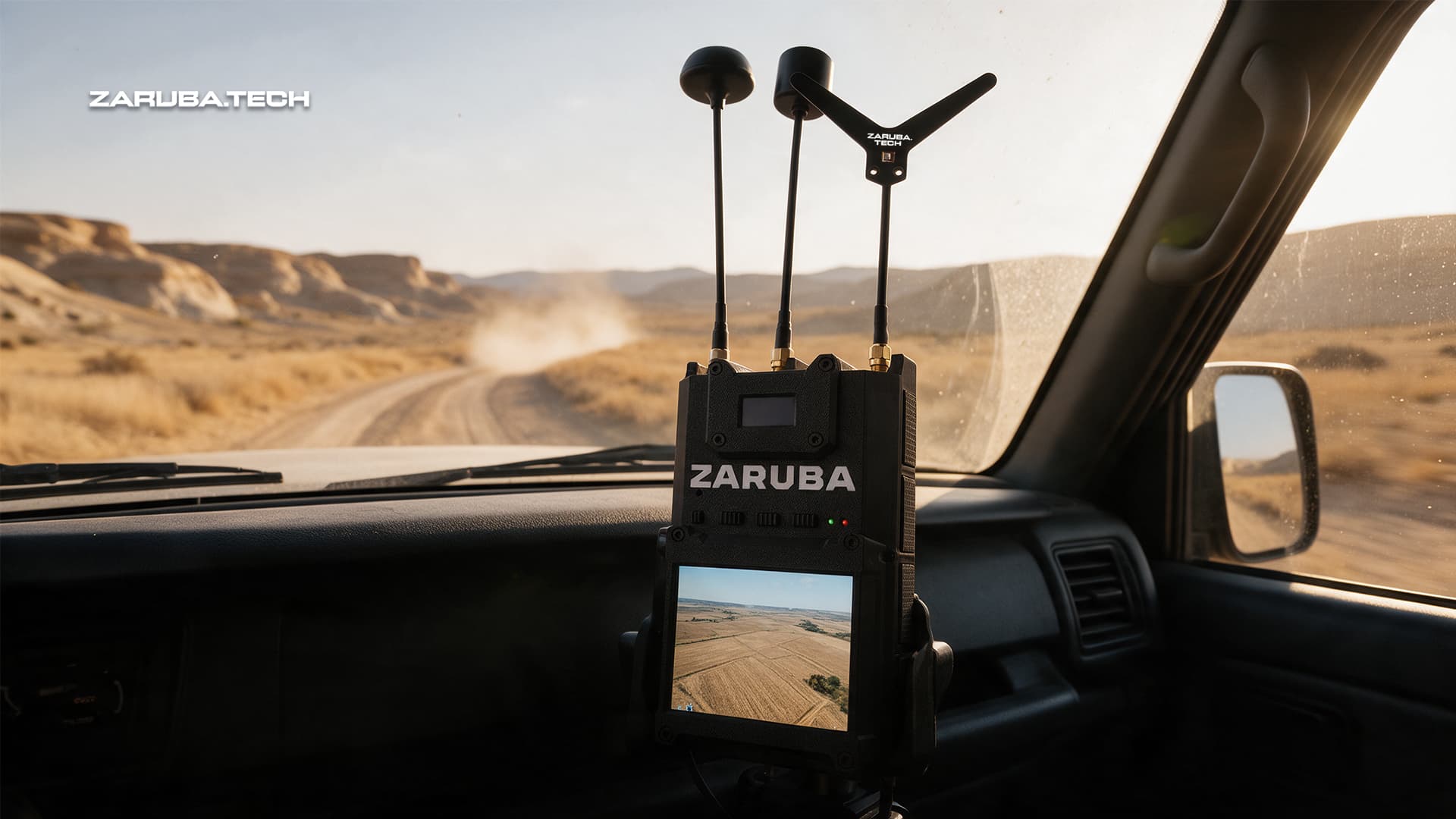
Zaruba A3 is a portable passive RF drone detector designed to identify analog FPV video signals across three supported RF bands. Its standalone design supports deployment in environments where fixed detection infrastructure is unavailable or impractical.
Depending on the operational setup, personnel can carry the Zaruba A3, position it at a temporary security point, or use it at a short-term facility where portable RF monitoring is required.
The operator is responsible for positioning the device, monitoring its indications, assessing alerts in context, and following established response procedures. Antenna placement, local interference, obstacles, and the transmitting UAV system's location can affect detection performance.
Because Zaruba A3 operates passively, it does not transmit RF signals to detect UAV activity or attempt to disrupt drone communications. It provides detection information that personnel can use alongside visual observation and other available sensors.
For mobile deployments, the key considerations are practical: the device can be transported between locations, runs on its internal battery, and requires no permanent installation. Actual detection results depend on the environment, supported signals, and deployment configuration.
Limitations of Portable RF Drone Detection
Portable RF detection is useful in mobile security operations, but its capabilities and limitations depend on the signals a detector is designed to receive.
What it detects
Zaruba A3 is designed to detect analog FPV video signals within its supported frequency bands (1.2 GHz, 3.3 GHz, and 5.8 GHz). Its detection capabilities should be evaluated against the RF systems used by the UAVs relevant to the intended deployment.
What it does not detect
A passive RF detector cannot reliably identify every UAV simply because it is within the device's nominal detection range. Drones that do not emit detectable signals in supported bands, use incompatible transmission technologies, or operate outside the detector's effective reception conditions may not be detected.
When additional sensors are needed
Additional sensors may be necessary when an operation requires broader detection coverage, visual confirmation, tracking, or detection of UAVs that do not produce compatible RF signals.
- Radar can detect and track airborne objects, including targets that may not emit detectable RF communications.
- Electro-optical and infrared (EO/IR) sensors can help visually confirm and classify observed objects, subject to visibility and environmental conditions.
- Acoustic sensors can provide an additional detection method in suitable environments, although background noise and range can limit performance.
Combining complementary detection technologies can provide broader situational awareness than relying on any single sensor.
Relevant Zaruba A3 Specifications
The following specifications are relevant when assessing Zaruba A3 for portable and temporary deployments.
- Frequency bands: 1.2 GHz, 3.3 GHz, and 5.8 GHz.
- Scanning speed: 4-8 seconds for a full cycle.
- Detection range: Up to 2.5 miles under suitable conditions.
- Battery life: 4,500 mAh battery capacity.
- Weight: Up to 23 oz.
- IP rating: IP54.
Related Drone Detection Resources
For a deeper understanding of passive RF detection and its role in counter-UAS systems, explore these resources:
Deploy Portable Drone Detection with Zaruba A3
Zaruba A3 by Zaruba Tech provides a portable passive RF detection option for teams that need to monitor compatible analog FPV signals at temporary positions or changing locations.
- Explore Zaruba A3
- Download A3 Datasheet
- Contact Sales