Portable Drone Detection for Law Enforcement Operations
Discover portable passive RF drone detection for law enforcement, tactical teams, and public safety. Explore Zaruba A3 capabilities and technical specifications.
Overview
Unmanned aerial vehicles (UAVs) create new challenges for law enforcement agencies responsible for public safety, tactical operations, and the protection of controlled areas. Unauthorized aerial surveillance, drone activity near sensitive locations, and potential interference with emergency response operations make timely drone awareness an important part of modern security planning.
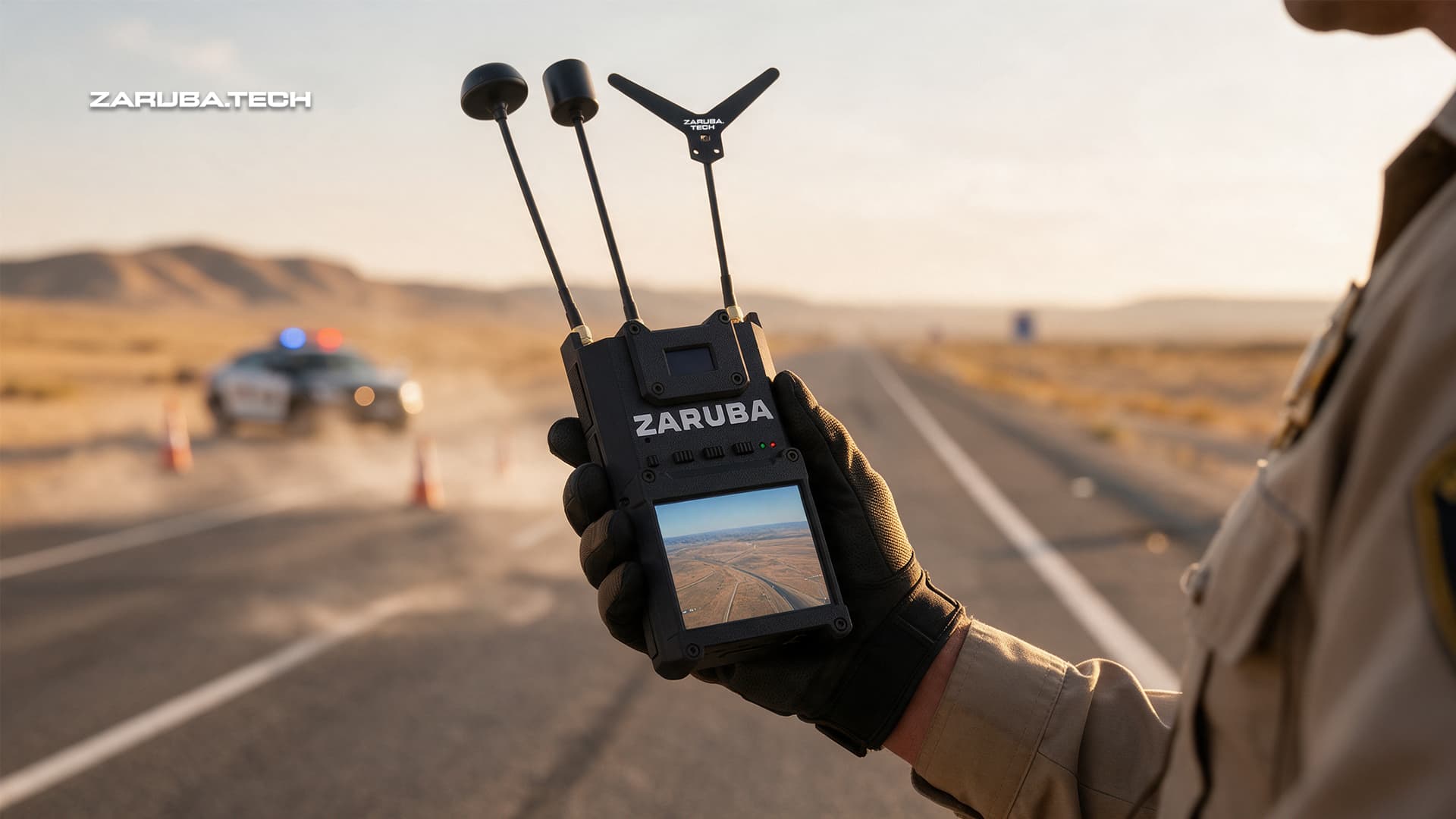
Portable passive radio-frequency (RF) detection provides an additional source of situational awareness by identifying compatible UAV-related transmissions without emitting RF signals. Zaruba A3 is designed to detect analog FPV video signals across three supported RF bands, offering law enforcement teams a portable option for monitoring potential drone activity during temporary deployments and field operations.
Other products by Zaruba Tech
Drone Risks for Law Enforcement Agencies
Drones can affect law enforcement operations in several ways, depending on their capabilities, the surrounding environment, and the intentions of their operators.
- Unauthorized surveillance: UAVs may be used to observe police activities, controlled areas, or sensitive locations without authorization.
- Interference with operations: Drone activity near emergency scenes or tactical operations can complicate situational awareness and require additional assessment by security personnel.
- Security incidents: An unidentified UAV near a restricted area or critical incident may require investigation to determine whether it presents a safety or security concern.
- Drones around controlled areas: Airports, correctional facilities, government buildings, and temporary restricted zones may face unauthorized drone activity that requires monitoring and an appropriate response.
Not every detected drone represents a threat. Effective drone awareness helps personnel identify potential activity and assess it in context rather than treating every detection as evidence of malicious intent.
When Law Enforcement Teams Need Drone Awareness
Drone detection can support law enforcement operations where aerial activity may affect personnel safety, operational security, or public protection.
- Tactical operations: Teams conducting high-risk interventions may benefit from additional information about compatible drone transmissions near an operational area.
- Major incidents: Emergency response scenes can involve multiple agencies, temporary perimeters, and changing security requirements. Drone awareness can supplement existing monitoring and coordination procedures.
- Public gatherings: Concerts, demonstrations, sporting events, and other large gatherings may require monitoring for unauthorized drone activity. Portable detection can support temporary security arrangements where compatible signals are present.
- High-risk operations: Operations involving sensitive locations, vulnerable individuals, or elevated security requirements may benefit from an additional source of information about potential UAV activity.
- Temporary security zones: Incident perimeters, restricted access areas, and temporary command posts may need drone detection without the time or resources required for permanent sensor installations.
The appropriate detection approach depends on the site, anticipated drone technologies, required coverage, and applicable legal and operational procedures.
How Passive RF Drone Detection Supports Situational Awareness
Passive RF drone detection receives and analyzes radio-frequency signals associated with compatible UAV systems. Unlike systems that actively transmit signals to detect targets, passive RF detectors monitor supported frequency bands without transmitting their own RF signals.
This approach supports law enforcement in three main ways:
- Passive monitoring: The detector receives compatible signals without actively transmitting or interfering with the communications being monitored.
- Early warning: When a detectable signal is identified, the device can provide an indication of potential UAV activity for personnel to assess.
- Portable detection: Standalone equipment can be transported between locations and deployed at temporary operational sites without requiring permanent detection infrastructure.
Passive RF detection has important limitations. It cannot reliably detect every drone, particularly systems that do not emit detectable signals in supported frequency bands. Its performance also depends on signal characteristics, antenna configuration, terrain, obstacles, and local RF interference.
For law enforcement agencies, passive RF detection is best understood as one component of a broader situational-awareness capability.
Portable Detection for Tactical Teams
Portable drone detection can provide an additional monitoring capability for specialized law enforcement teams operating in environments where fixed infrastructure is unavailable or impractical.
- SWAT teams: Portable RF detection can supplement existing observation and security procedures during tactical deployments where compatible UAV transmissions may be relevant.
- Special response teams: Personnel responding to high-risk incidents can use detection information as one input when assessing activity around an operational area.
- Bomb squads: During explosive-device investigations and related operations, portable detection may contribute to situational awareness around a temporary security perimeter. It does not replace established explosive-device procedures or other required safety measures.
- Temporary command locations: Command posts established at incident scenes can use portable equipment to add a local RF monitoring capability without installing a permanent system.
In these scenarios, the detector provides information for the operator to interpret. Its indications should be considered alongside visual observations, incident intelligence, and information from other available sensors.
How Zaruba A3 Can Support Law Enforcement Operations
Zaruba A3 is a portable passive RF drone detector designed to identify analog FPV video signals across three supported RF bands: 1.2 GHz, 3.3 GHz, and 5.8 GHz.
Its portable design supports use at temporary security locations, incident command posts, and other sites where personnel require a standalone means of monitoring compatible RF transmissions.
Key characteristics relevant to law enforcement include:
- Passive operation: Zaruba A3 does not transmit RF signals to detect UAV activity or disrupt detected communications.
- Three-band detection: The device scans supported frequency bands associated with analog FPV video transmissions.
- Portable deployment: Its compact form supports transportation between operational locations.
- Battery-powered operation: A built-in 4,500 mAh battery allows use without a continuous external power connection.
- Field-oriented construction: An IP54 rating provides protection against limited dust ingress and water splashes, subject to the device's operating requirements.
During an operation, personnel can monitor the device's indications and assess whether further investigation is necessary. Detection results should be interpreted in context, as a detected signal does not by itself establish the identity, location, or intent of a drone operator.
Zaruba A3 is intended for detecting compatible analog FPV video signals. It should not be treated as a universal detector for all commercial, recreational, or other UAV systems.
Limitations of RF-Only Detection
Passive RF detection can contribute valuable information, but law enforcement agencies should understand the distinction between detecting a signal, identifying a drone, and mitigating a threat.
Detection does not equal identification
A detected RF signal does not automatically establish the type of UAV, the identity of its operator, or whether the activity is unauthorized. Additional information, such as visual confirmation or data from complementary sensors, may be necessary to assess the incident.
Detection does not equal mitigation
Passive RF detection identifies compatible signals; it does not neutralize a drone, interrupt its communications, or prevent it from entering a restricted area. Any response or mitigation action must be handled separately and in accordance with applicable law, agency authority, and established procedures.
Signal type and frequency limitations
RF detection depends on the frequencies and signal types supported by the device. Zaruba A3 is designed for analog FPV video transmissions across its supported bands. UAVs using unsupported frequencies, incompatible digital systems, or transmission modes that do not produce detectable signals may not be detected.
Environmental limitations
Buildings, vegetation, terrain, interference, and antenna placement can affect signal reception. A stated maximum detection range should not be interpreted as guaranteed performance in every environment.
The role of complementary sensors
Depending on operational requirements, law enforcement agencies may combine passive RF detection with other technologies:
- Radar can detect and track airborne objects without relying on the target emitting a detectable communication signal.
- Electro-optical and infrared (EO/IR) sensors can support visual confirmation and classification when viewing conditions permit.
- Acoustic sensors can provide additional information in suitable environments, although background noise and range can limit performance.
A layered approach can provide broader situational awareness than relying on RF detection alone.
Relevant Zaruba A3 Specifications
The following specifications are relevant when evaluating Zaruba A3 for law enforcement and public-safety applications.
- Frequency bands: 1.2 GHz, 3.3 GHz, and 5.8 GHz.
- Scanning speed: 4-8 seconds for a full cycle.
- Detection range: Up to 2.5 miles under suitable conditions.
- Battery life: 4,500 mAh battery capacity.
- Weight: Up to 23 oz.
- IP rating: IP54.
- Operating temperature: 14°F to 122°F
Related solutions
- Event Security Drone Detection
- Mobile Drone Detection
- Protective Security Drone Detection
Related resources
- FPV Drone Detection: Capabilities and Limitations
- How Passive RF Drone Detection Works
- Counter-UAS Detection Layers
Portable Drone Detection for Law Enforcement
Zaruba Tech offers a portable passive RF detector Zaruba A3 for law enforcement teams that need to monitor compatible analog FPV video transmissions during tactical operations, incident response, and temporary security deployments.
- Explore Zaruba A3
- Request a Demo
- Contact Sales