FPV Drone
Bebradrone
Unmanned aerial platform for long-range autonomous missions.
Testing our devices at a military training ground
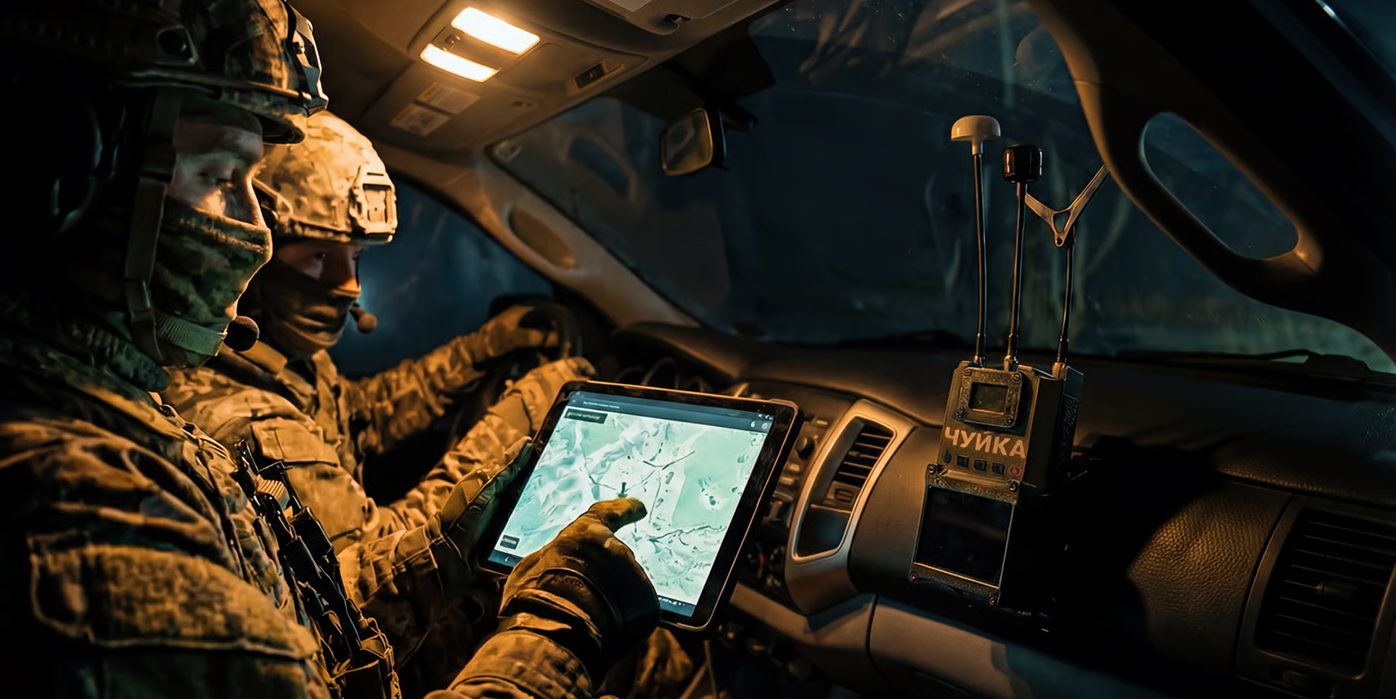
Testing our devices at a military training ground
Modification and technical characteristics
"Bebradrone" UAV

"Bebradrone" UAV is a tactical fixed-wing unmanned platform designed for fire correction and air support missions at medium ranges. Its design is focused on rapid deployment in field conditions and compatibility with standard control and video surveillance systems used by units.
Launch is carried out using a compact pneumatic catapult designed specifically for this platform. When folded, the catapult has dimensions comparable to the aircraft itself, which simplifies transportation and deployment in mobile field conditions.
Key Features
Flight control is carried out by the operator in real time via a radio channel, which allows precise control of the flight trajectory and effective operation within the tactical deployment zone.
Flight control is carried out by the operator in real time via a radio channel, which allows precise control of the flight trajectory and effective operation within the tactical deployment zone.
Technical characteristics
Flight control is carried out by the operator in real time via a radio channel, which allows precise control of the flight trajectory and effective operation within the tactical deployment zone.
The low-light camera ensures effective operation in reduced lighting conditions, improving visibility in the evening, early morning, and at night, thereby expanding the drone's operational capabilities throughout the day.
The UAV is not equipped with an automatic homing system; control and course correction are performed manually by the operator via the control link.
The analog video transmission system operates at 5.8 GHz, with the option to use additional 3.3 GHz, 1.2 GHz, or 7 GHz bands, allowing the selection of the optimal frequency range depending on radio environment conditions.
Technical characteristics
Flight control is carried out by the operator in real time via a radio channel, which allows precise control of the flight trajectory and effective operation within the tactical deployment zone.
The low-light camera ensures effective operation in reduced lighting conditions, improving visibility in the evening, early morning, and at night, thereby expanding the drone's operational capabilities throughout the day.
The UAV is not equipped with an automatic homing system; control and course correction are performed manually by the operator via the control link.
The analog video transmission system operates at 5.8 GHz, with the option to use additional 3.3 GHz, 1.2 GHz, or 7 GHz bands, allowing the selection of the optimal frequency range depending on radio environment conditions.